


Argyle, Texas, nestled in the heart of prosperous Denton County, is where luxury meets small-town charm. It’s a place defined by rolling acreage estates, top-rated schools, and a deep sense of community pride.
Families are drawn here for its serenity and the prestige of the Argyle Independent School District (AISD). But make no mistake—living in Argyle comes at a premium.
This guide breaks down Argyle TX cost of living, comparing it to both the broader Dallas–Fort Worth Metroplex and the national average.

The Big Picture: Argyle’s Overall Cost Index
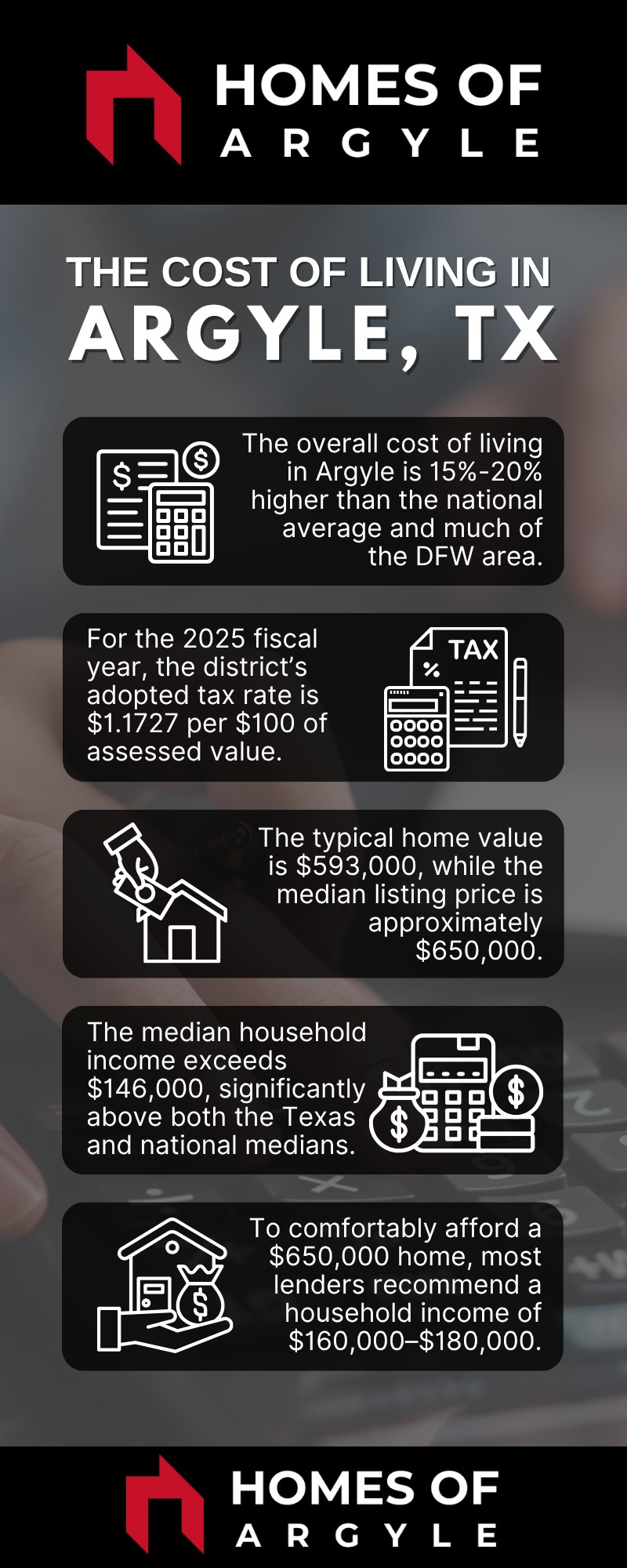
The overall cost of living in Argyle TX is estimated to be 15% to 20% higher than both the national average and much of the DFW area. While essentials like groceries and utilities remain moderate, the real driver of Argyle’s elevated index is its housing market.
Housing prices are the single largest factor pushing Argyle’s cost of living upward. As of September 2025, the typical home value is around $593,000, while the median listing price is approximately $650,000.
Some estimates place the average home price near $841,000, reflecting the abundance of custom homes on large lots. By contrast, Texas’s statewide median home value hovers closer to $320,000—meaning Argyle real estate costs roughly double the state norm.
The sticker shock is softened somewhat by Argyle’s affluence. The median household income exceeds $146,000, significantly above both the Texas ($75,000) and national ($81,000) medians.
High-earning professionals and business owners are the norm here, enabling most households to comfortably manage higher home and lifestyle costs.

Deep Dive into Housing: The High Price of Space
When it comes to Argyle TX housing market affordability, home values typically range from $650,000 to $800,000. Buyers can look forward to generous space, high-end finishes, and a strong return on investment.
Custom estates with acreage lots and modern farmhouse designs dominate the landscape.
Homes in Argyle often feature 3,000+ square feet, outdoor living areas, and premium materials—features that explain the pricing gap compared to surrounding cities like Denton or Corinth.
If buying isn’t in the cards, be prepared for a tight rental market. Argyle’s inventory of rental homes is limited, and competition is fierce.
A standard three- or four-bedroom home often rents for $3,000 to $3,500 per month, depending on community and amenities. Luxury homes or properties within master-planned neighborhoods like Harvest and Canyon Falls can easily surpass that range.
Living in Argyle is as much a lifestyle choice as a financial one. From equestrian estates and gated acreage properties to family-friendly master-planned communities with resort-style pools and fitness centers, every neighborhood reflects a standard of comfort.
The premium Argyle TX property values is for privacy, land, and community prestige—not just square footage.

The Property Tax Paradox
One of Texas’s quirks is its lack of a state income tax. While this helps offset some costs, property taxes fill that gap.
Homeowners in Argyle shoulder some of the highest effective property tax rates in the DFW area—but those funds directly support the area’s excellent schools and infrastructure.
The Argyle Independent School District (AISD) is a major contributor to both the appeal and expense of local living. Known for academic excellence and athletic achievement, AISD consistently ranks among the top in North Texas.
For the 2025 fiscal year, the district’s adopted tax rate is $1.1727 per $100 of assessed value.
Argyle homeowners also pay taxes to Denton County, the Town of Argyle, and various special districts. Combined, the total effective property tax rate averages around 2.2%—though some estimates place it as low as 1.5% depending on exemptions.
Agricultural exemptions (for qualified acreage lots) can significantly reduce property tax liability, making large parcels more affordable to maintain.

Utilities and Everyday Expenses
Argyle’s grocery prices tend to hover just below the national average, but slightly above the Texas state average. Shoppers rely on nearby grocery hubs in Denton and Flower Mound, including H-E-B, Kroger, and Whole Foods.
Argyle residents benefit from Texas’s deregulated energy market, which allows households to shop for electricity providers. Depending on the plan, rates can be competitive—sometimes 5%–10% lower than the national average.
However, bills can still fluctuate seasonally due to summer cooling demands.
Healthcare costs run slightly higher than national norms, reflecting the region’s growing affluence and hospital expansions in Denton and Flower Mound.
Meanwhile, transportation expenses remain moderate. Fuel prices are close to the state average, and being part of the DFW Metroplex means residents enjoy relatively short drives to major employers, airports, and entertainment hubs.
Transportation and Connectivity
Argyle is undeniably car-dependent. The vast majority of residents commute to job centers in Denton, Fort Worth, or Dallas, with the average drive to downtown Fort Worth taking about 35 to 45 minutes during rush hour.
Connectivity is a strong point, with U.S. Highway 377 running through town and I-35W just minutes away. These routes make commuting relatively efficient while preserving Argyle’s small-town feel.
Despite its proximity to major highways, Argyle retains a relaxed, rural charm. Residents enjoy easy access to Grapevine Lake and Lewisville Lake, offering boating, fishing, and outdoor recreation.
Locally owned restaurants, farmers’ markets, and equestrian centers round out the town’s appeal.
Frequently Asked Questions
How much higher is the cost of buying a home in Argyle compared to Denton?
Typically 40–60% higher, depending on size, age, and neighborhood.
What is the current property tax rate for homeowners within the Argyle ISD boundary?
About $1.17 per $100 of valuation for AISD, with a total effective rate near 2.2% when including county and town taxes.
Do grocery and utility costs rise or fall depending on location within Argyle?
Slightly. Homes in master-planned communities may have HOA fees and energy-efficient designs that offset some costs.
What is the minimum annual income to afford the median home price in Argyle?
To comfortably afford a $650,000 home, most lenders recommend a household income of $160,000–$180,000.
Can I use an agricultural exemption on my property taxes, and how much land is required?
Yes, if you maintain qualified agricultural use. Typically, 5–10 acres are required, though Denton County sets specific criteria.
How long is the commute from Argyle to Downtown Fort Worth during rush hour?
Roughly 35 to 45 minutes, depending on traffic conditions along I-35W.
Is Argyle’s reputation for excellent schools justified by recent state ratings?
Absolutely. AISD consistently earns A ratings from the Texas Education Agency and is considered one of the region’s best-performing districts.
Key Takeaway
The cost of living in Argyle is best viewed as an investment in lifestyle. Between top-tier schools, expansive homes, and access to both city and countryside, residents enjoy one of North Texas’s most desirable addresses.
While you’ll pay more for housing and taxes, you gain the peace, prestige, and privacy that come with a community designed for excellence. For high-earning families seeking a serene suburban retreat near DFW’s job centers, Argyle delivers exceptional value—just with a higher price tag attached.
If you’d like to explore the neighborhoods in Argyle, TX, feel free to give me a call today at 469-803-9041 or send me an email at costimhinn@gmail.com to schedule an appointment.