


Argyle, Texas, has a reputation for excellent schools, generous lot sizes, and a quieter way of life that still sits close to major job centers in Denton and Fort Worth. But one thing buyers consistently tell me catches them by surprise? The property tax bill.
It’s not that Argyle’s taxes are unusually high for Texas — it’s that the structure is layered, complex, and different from what many people are used to.
If you’re planning a move here, understanding how the taxes are built will help you make a confident, financially sound decision.
This guide walks through how Argyle, Texas, property taxes work, what the 2024 rates look like, how special districts like MUDs affect your total payment, and how exemptions can reduce your bill.

The Argyle Tax Equation
Texas is one of only a handful of states with no state income tax. Because of that, cities, counties, and especially school districts rely heavily on property taxes to fund local services.
Every homeowner pays a combination of several independent tax rates added together.
Here’s what forms your total rate in Argyle:
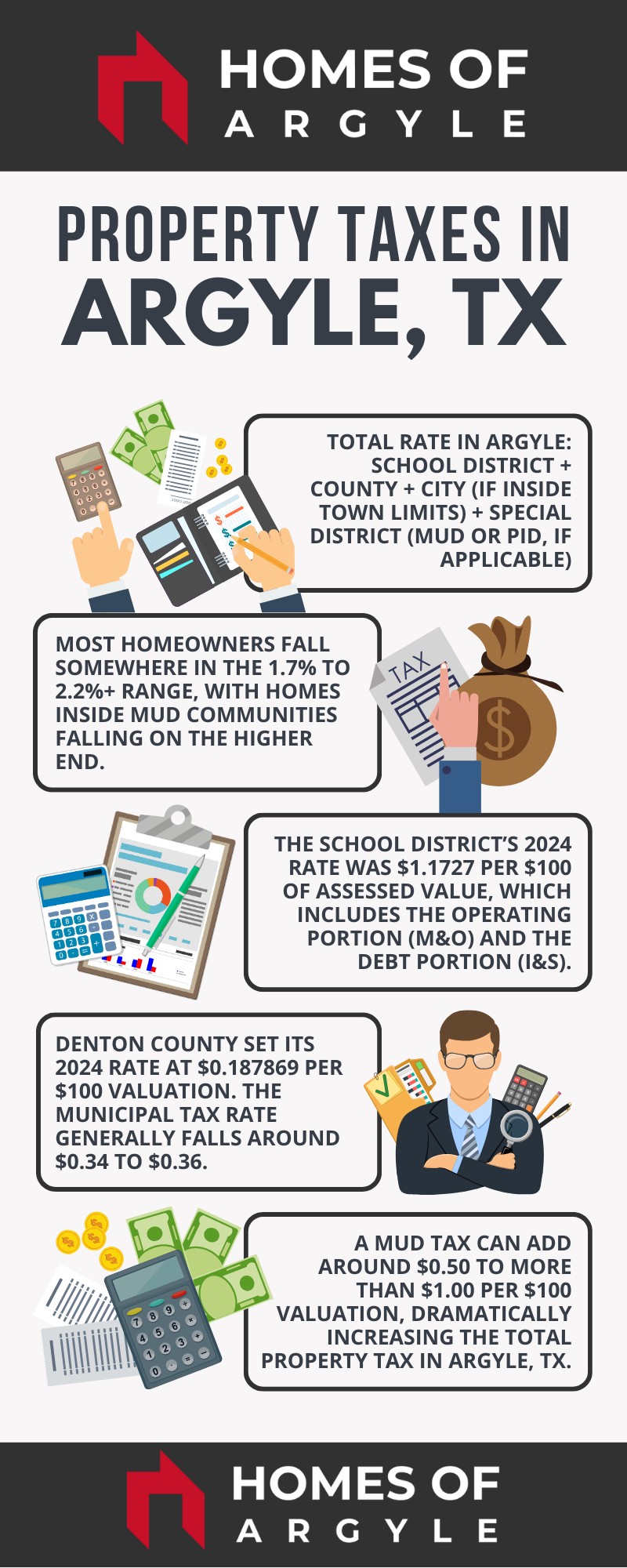
School District + County + City (if inside town limits) + Special District (MUD or PID, if applicable)
Because neighborhoods fall under different jurisdiction combinations, total Argyle, TX, property tax rates vary. Most Argyle homeowners fall somewhere in the 1.7% to 2.2%+ range, with homes inside MUD communities falling on the higher end.

Breaking Down the 2024 Tax Rates
For 2024, here’s how the primary taxing entities in Argyle were structured:
Argyle ISD
The school district’s 2024 rate was $1.1727 per $100 of assessed value, which includes the operating portion (M&O) and the debt portion (I&S). For most homeowners, this is the single biggest component of the tax bill.
Denton County
Denton County set its 2024 rate at $0.187869 per $100 valuation, a slight decrease from previous years.
Town of Argyle
If your home is inside Argyle’s town limits, the municipal tax rate generally falls around $0.34 to $0.36. These funds support police, roads, and general town services.
Add them together, and you have a typical non-MUD Argyle rate before exemptions.

The “Hidden” Costs — MUDs and PIDs
This is where many buyers get caught off guard, especially when shopping newer master-planned communities.
What is a MUD?
A Municipal Utility District (MUD) is a special taxing district created to build and maintain water, sewer, drainage, and road systems in developing neighborhoods.
Instead of the city paying for infrastructure upfront, the MUD issues bonds — and homeowners repay those bonds through an additional MUD tax.
These districts are common in communities like Harvest and Canyon Falls.
Cost Impact
A MUD tax can add around $0.50 to more than $1.00 per $100 valuation, dramatically increasing the total property tax in Argyle, TX.
This can easily push a home’s effective tax rate above 2.5%, sometimes even higher depending on the neighborhood.
Public Improvement Districts (PIDs)
While MUDs use tax rates, PIDs typically charge a fixed annual assessment or a multi-year payoff. These help fund community improvements like landscaping, parks, and entrance monuments.
Both MUDs and PIDs impact your bottom line, so it’s essential to identify whether a property lies inside one.

Calculating Your Bill: A Real-World Example
Here’s a simple formula used statewide:
(Assessed Value ÷ 100) × Total Tax Rate = Annual Property Tax Bill
Now let’s look at what this means for a typical Argyle home.
Scenario A — Home Without a MUD/PID
- Home value: $650,000
- Total tax rate: 1.85%
- Calculation: (650,000 ÷ 100) × 1.85
- Annual Tax Bill: $12,025
Scenario B — Home Inside a MUD Community
- Same home value: $650,000
- Total tax rate with MUD: 2.60%
- Calculation: (650,000 ÷ 100) × 2.60
- Annual Tax Bill: $16,900
Difference: roughly $4,800 per year.
This is why two homes with the same list price can have completely different monthly costs.
Exemptions and SavingsExemptions and Savings
Texas offers several exemptions that reduce taxable value and lighten the bill.
Homestead Exemption
For primary residences, the school district homestead exemption lowers the taxable value, offering meaningful savings every year.
Over-65 and Disabled Exemptions
Homeowners who are 65 or older — or disabled — qualify for additional exemptions and benefit from a school tax freeze. Once the freeze is applied, the school portion of the tax bill can no longer increase.
Agricultural (Ag) Exemptions
For properties with qualifying acreage used for agricultural purposes (such as livestock or crops), the land can be taxed at a much lower “productive value” instead of market value. This can dramatically reduce annual taxes on larger tracts.
Frequently Asked Questions
What is the total property tax rate for a home in the Harvest community?
Harvest includes MUDs and sometimes PIDs, so rates are typically higher — often well above 2.5%, depending on the specific section.
How can I tell if a property is inside a MUD or a PID?
Check the property’s tax statement or ask your real estate agent. MUDs and PIDs appear as separate line items on the annual tax bill.
When does the Denton Central Appraisal District send appraisal notices?
Appraisal notices usually go out in April, giving homeowners time to review values and file protests if needed.
Can I protest my property tax appraisal?
Absolutely. If you believe your assessed value is too high, you can protest it, submit evidence, and request a hearing.
Does the Argyle ISD tax rate change every year?
It can. School districts adjust rates annually based on operational needs, debt payments, and state funding formulas.
Is there a difference between the Town of Argyle and the ETJ?
Yes. Properties in the ETJ typically do not pay town taxes, though they still pay county, school, and any special district taxes.
How much does the Homestead Exemption save?
Savings vary depending on the home’s value, but even a modest exemption can reduce the annual bill by hundreds of dollars or more.
Key Takeaway
In Argyle, location determines your tax rate just as much as your home price does. A home in a MUD community may look like a great deal upfront, but still cost more each month because of the added tax burden.
Meanwhile, established neighborhoods without special districts generally offer lower ongoing costs.
Before buying, look at the full tax rate, not just the asking price — it’s one of the most important steps in understanding your true cost of ownership.
We can guide you through your entire home-buying journey. Please don’t hesitate to contact us today at 469-803-9041or costimhinn@gmail.com to schedule an appointment.